
The introductory Discussion Paper on Predictability Lead Time™ has been syndicated across more than 300 news and media websites, including USA Today, AP News, Business Insider Markets, Benzinga and StreetInsider.
Violence Against Healthcare Workers Remains a Persistent Challenge
What If We're Asking
The Wrong Question?
Predictability Lead Time™
A structured analytical methodology for examining when developing risk of violence against healthcare workers could reasonably have been recognized as becoming predictable, and what recognition lead time may have existed before harm occurred.
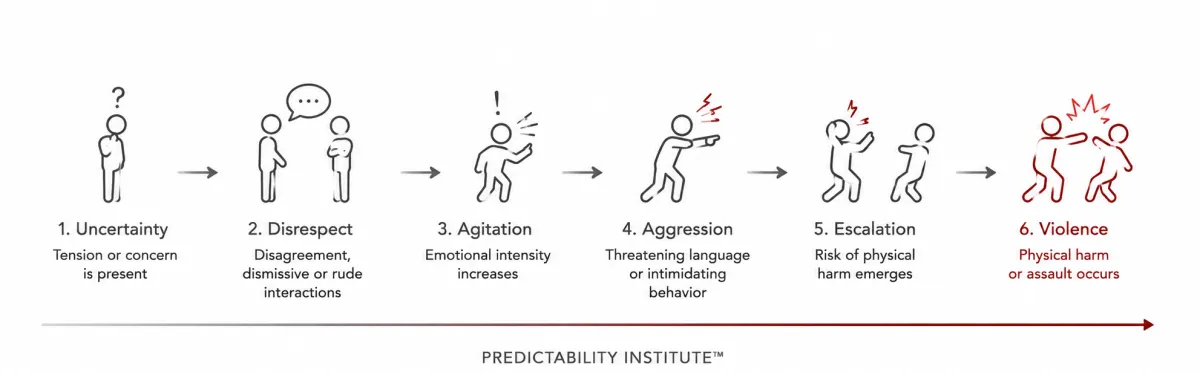
Despite decades of policies, reporting systems, staff education, incident investigations, and prevention initiatives, violence against healthcare workers continues to occur across healthcare settings around the world.
Healthcare has faced seemingly intractable challenges before.
Patient safety demonstrated that changing how healthcare thinks can dramatically change outcomes.
Predictability Lead Time™ examines when developing risk of violence against healthcare workers could reasonably have been recognized as becoming predictable, what recognition lead time may have existed, and what organizations can learn from that opportunity.
Why This Matters
Patient safety did not transform healthcare because organizations simply investigated more incidents. It transformed healthcare because the profession began asking different questions. That shift led to new ways of understanding systems, communication, risk, and preventable harm.
Today, violence against healthcare workers remains one of healthcare's most persistent safety challenges.
Predictability Lead Time™ provides a structured way to examine recognition opportunities that conventional post-incident approaches may not be designed to measure, including whether organizations are learning to recognize developing risk earlier over time.
"The measure of a healthcare system is not only how well it protects its patients,
but how unwilling it is to accept predictable harm to the people who care for them."
Alison Prentice
Founder, Predictability Institute™
"that's just how it is"
The Story Behind the Question
Predictability Lead Time™ began with a question that stayed with me throughout my nursing and healthcare leadership career:
When could an event reasonably have been recognized as becoming predictable?
The question crystallized after I heard the events leading up to a nurse being seriously injured at work. As the story unfolded, it became difficult to ignore how many warning signs had accumulated before the assault occurred. Staff knew the risks. Management knew the risks. Everyone was waiting for a longer-term solution.
After the nurse suffered two broken ribs in two months, concerns were raised. The response was simple:
"That's just how it is."
That moment changed how I thought about violence against healthcare workers. Rather than asking only why an incident occurred, I began asking whether there was an earlier point at which the developing situation could reasonably have been recognized as becoming predictable.
That question became the foundation for the Predictability Lead Time™ methodology.
RECOGNIZING WHEN VIOLENCE BECOMES REASONABLY PREDICTABLE
A Different Way to Think About violence against healthcare workers
Most investigations into violence against healthcare workers begin by asking why an incident occurred.
Predictability Lead Time™ begins with a different question:
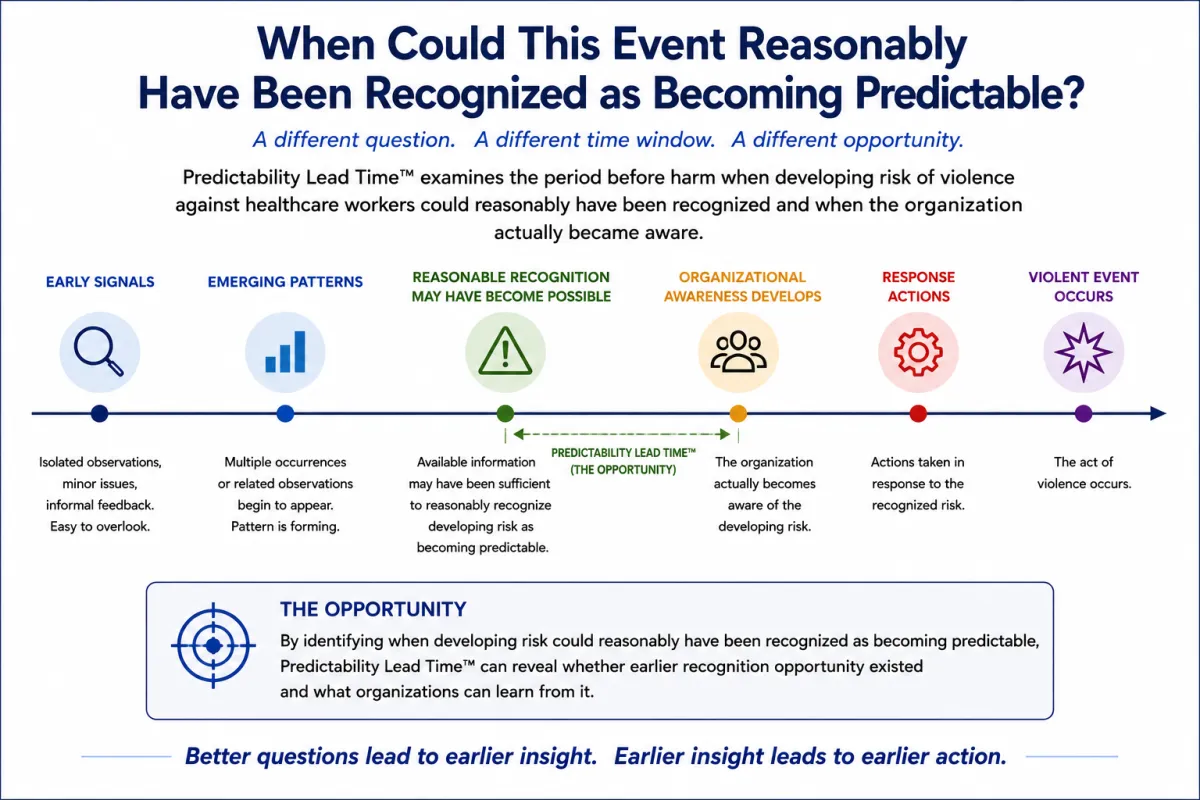
When could this event reasonably have been recognized as becoming predictable?
That subtle shift changes the analytical perspective. Instead of beginning with why violence occurred, PLT examines how risk developed before harm took place and when the available information may have been sufficient for the developing risk to be reasonably recognized as becoming predictable.
Asking a different question naturally leads to examining different aspects of an event.
The methodology provides a structured approach for examining:
How developing risk changes over time.
How signals and patterns accumulate rather than exist in isolation.
When available information may have supported reasonable recognition.
When organizational awareness actually developed.
What recognition lead time, if any, may have existed before harm occurred.
What happened between recognition, organizational awareness, response, intervention, and harm.
The methodology is designed to complement existing investigation processes rather than replace them.

ASK A DIFFERENT QUESTION
Move beyond asking only “Why did this happen?” to also ask: “When could this
event reasonably have been recognized
as becoming predictable?”

THINK DIFFERENTLY ABOUT PREDICTABILITY
Apply a structured analytical methodology to examine how developing risk evolved and when reasonable recognition may have become possible before violence occurred.

CREATE DIFFERENT OPPORTUNITIES
Identify opportunities for earlier recognition, understand available recognition lead time, and examine whether that time could support earlier organizational response.
The Methodology
Built Around a Structured Assessment Methodology
Predictability Lead Time™ is a structured methodology for retrospective analysis of developing risk of violence against healthcare workers.
It examines when reasonable recognition may have become possible, when organizational awareness actually developed, what recognition lead time may have existed, and what occurred between recognition and harm.
The methodology is supported by defined analytical constructs, controlled assessment processes, implementation governance, validation requirements, and explicit human decision authority.
Digital and AI-supported systems may assist defined functions, but they do not replace governed methodology or accountable human judgment.
Recognition
Predictability Marker™
Predictability Timeline™
ORGANIZATIONAL RESPONSE
Organizational Awareness Timeline™
Response Intervals™
Intervention Intervals™
GOVERNANCE & LEARNING
Methodological Fidelity
Validation & Revalidation
Organizational Learning
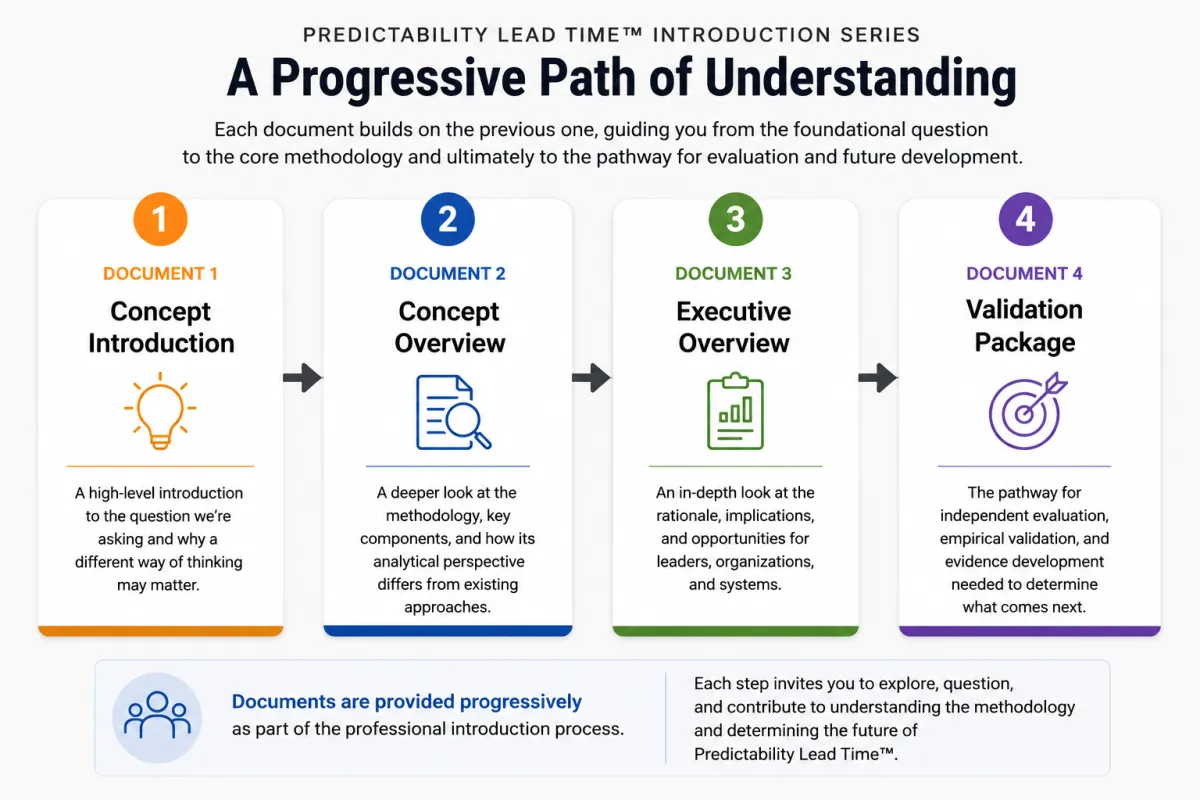
The methodology is introduced in the Concept Overview and explored in greater depth throughout the Executive Overview and Validation Package.
Building Interest Before Implementation
Who We're Inviting to Explore Predictability Lead Time™
Predictability Lead Time™ is being introduced to healthcare professionals, researchers, academic institutions, and potential strategic partners interested in exploring whether this different analytical perspective may contribute to a better understanding of violence against healthcare workers.
The immediate objective is not implementation.
It is to encourage professional discussion, independent evaluation, and collaboration around a new way of thinking about predictable violence.
The immediate objective is straightforward.
Determine whether this different way of thinking warrants further professional evaluation, collaboration, research, software development, and future implementation.
Professional interest comes first. Evidence follows.
Healthcare Leaders
Explore whether Predictability Lead Time™ offers a different way of understanding and learning from violence against healthcare workers.
Quality Improvement Specialists
Evaluate how a different analytical perspective may complement existing quality improvement methodologies.
Risk Management Professionals
Examine how earlier recognition of predictable harm may strengthen organizational risk assessment.
Researchers
Evaluate, challenge, refine, or validate the framework through independent research and scholarly investigation.
Academic Institutions
Explore opportunities for collaborative research, scholarly discussion, curriculum development, and future educational applications.
Health Informatics Organizations
Explore how structured predictability assessment could inform future healthcare information systems and analytical tools.
Potential Commercialization Partners
Explore opportunities to responsibly develop and commercialize Predictability Lead Time™ following professional evaluation and growing evidence.
learn more
The Predictability Lead Time™ Introduction Series has been developed to introduce the methodology in stages. Each document builds on the one before it, allowing readers to explore the methodology in progressively greater depth.
REQUEST THE FIRST IN THE SERIES BELOW
Start the Conversation
Ready to Explore a Different Way of Thinking?
If this methodology is relevant to your work, request the first document in the Predictability Lead Time™ Introduction Series below.
PRIVACY
Your information will be used only to provide access to this publication and to notify you of significant future publications and developments related to Predictability Lead Time™. Your information will not be sold or shared with third parties.


Patient safety changed healthcare by changing how healthcare thought about harm. Predictability Lead Time™ begins by asking whether violence against healthcare workers deserves the same willingness to think differently.

Predictability Institute™ advances new ways to understand and measure predictable harm in healthcare through research, structured assessment methodologies, and professional collaboration.
© 2026 Predictability Institute™. All rights reserved. Predictability Institute™, Predictability Lead Time™, Predictability Marker™, Predictability Timeline™, Organizational Awareness Timeline™, Organizational Awareness Interval™, Response Interval™, Intervention Interval™, and Organizational Acceptance of Predictable Harm™ are trademarks of Alison Prentice.
© 2026 Predictability Institute™ . All rights reserved