
The introductory Discussion Paper on Predictability Lead Time™ has been syndicated across more than 300 news and media websites, including USA Today, AP News, Business Insider Markets, Benzinga and StreetInsider.
Discussion Paper No. 1
Predictability Lead Time™
Why Assessing Individual Violence Risk Is Different from Recognizing When Violence Becomes Reasonably Predictable
Violence against healthcare workers remains one of healthcare's most persistent occupational health and safety challenges. Despite significant advances in violence prevention, violence risk assessment, and post-incident investigation, important questions remain about how violent incidents develop before harm occurs.
This discussion paper introduces Predictability Lead Time™, a proposed analytical framework that examines a different question:
When did this act of violence become reasonably predictable?
Rather than attempting to predict whether an individual will become violent, the framework explores whether the predictability of a developing situation may evolve through the interaction of clinical, behavioural, communication, operational, environmental, and organizational factors.
The paper positions Predictability Lead Time™ within the existing literature on workplace violence, violence risk assessment, systems thinking, and organizational learning. It also outlines a proposed pathway for retrospective validation and future organizational application.
Predictability Lead Time™ is presented as a proposed analytical framework intended to stimulate professional discussion, independent evaluation, methodological refinement, and future research. It is not presented as a validated methodology or as a replacement for existing workplace violence prevention strategies, violence risk assessment, or post-incident investigation processes.
Reach, Engage, contribute
Inside This Discussion Paper
The ongoing challenge of violence against healthcare workers.
How violence risk assessment has evolved over time.
An analytical gap not specifically addressed by current methodologies.
The distinction between individual predictability and situational predictability.
The conceptual foundations of Predictability Lead Time™.
A proposed pathway for scientific validation.
Potential applications and future research directions.
Potential applications and future research directions.
Who Should Read This Paper?
This publication has been written for:
Healthcare executives
Nursing leaders
Quality improvement professionals
Risk management professionals
Occupational health and safety leaders
Workplace violence specialists
Researchers
Academic institutions
Health policy professionals
Healthcare technology organizations

PRIVACY
Your information will be used only to provide access to this publication and to notify you of significant future publications
and developments related to Predictability Lead Time™. Your information will not be sold or shared with third parties.
learn more
The Predictability Lead Time™ Introduction Series has been developed to introduce the methodology in stages. Each document builds on the one before it, allowing readers to explore the methodology in progressively greater depth.
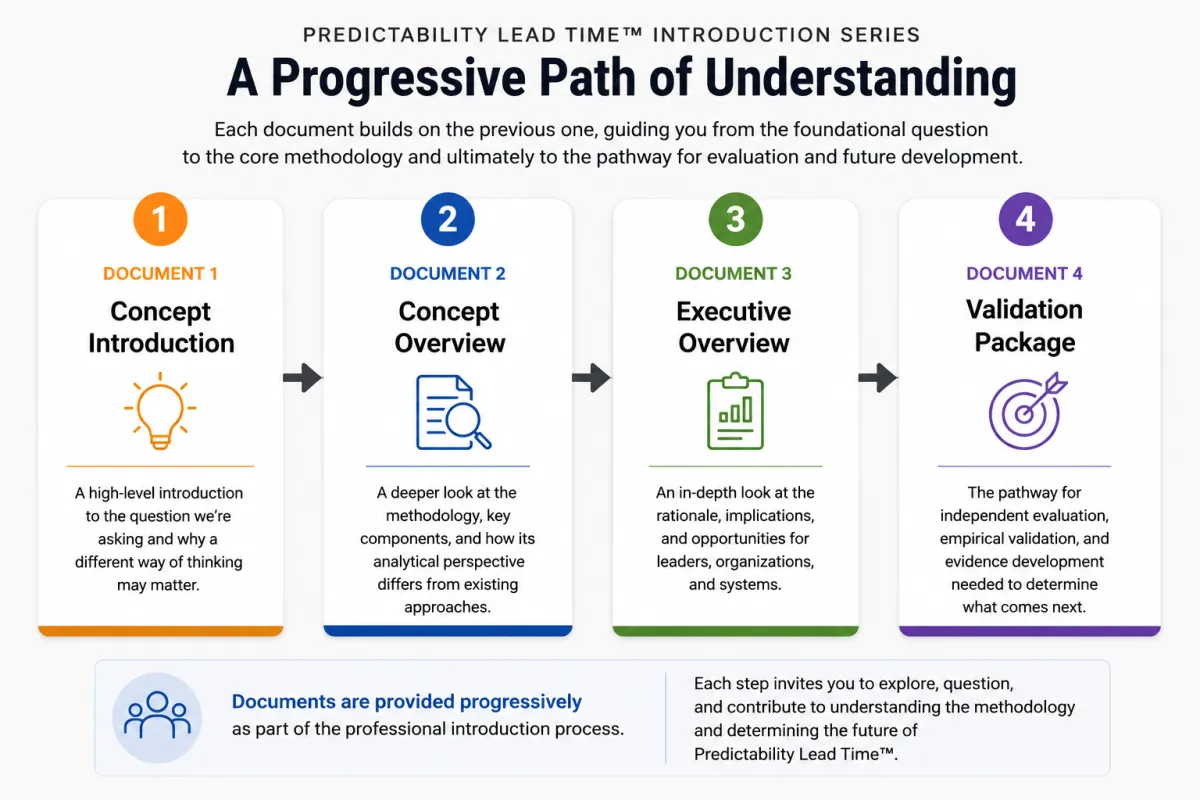
REQUEST THE FIRST IN THE SERIES BELOW
Start the Conversation
Ready to Explore a Different Way of Thinking?
If this methodology is relevant to your work, request the first document in the Predictability Lead Time™ Introduction Series below.
PRIVACY
Your information will be used only to provide access to this publication and to notify you of significant future publications and developments related to Predictability Lead Time™. Your information will not be sold or shared with third parties.


Patient safety changed healthcare by changing how healthcare thought about harm. Predictability Lead Time™ begins by asking whether violence against healthcare workers deserves the same willingness to think differently.

Predictability Institute™ advances new ways to understand and measure predictable harm in healthcare through research, structured assessment methodologies, and professional collaboration.
© 2026 Predictability Institute™. All rights reserved. Predictability Institute™, Predictability Lead Time™, Predictability Lead Time Index™, Predictability Window™, Predictability Marker™, Predictability Timeline™, Organizational Awareness Timeline™, Organizational Awareness Interval™, Response Interval™, Intervention Interval™, Predictability Confidence Indicator™, Predictability Maturity Model™, Predictability Assessment Lifecycle™, and Organizational Acceptance of Predictable Harm™ are trademarks of Alison Prentice.
© 2026 Predictability Institute™ . All rights reserved