
The introductory Discussion Paper on Predictability Lead Time™ has been syndicated across more than 300 news and media websites, including USA Today, AP News, Business Insider Markets, Benzinga and StreetInsider.
ADVANCING EARLIER RECOGNITION OF DEVELOPING VIOLENCE RISK
Predictability Institute™ was established to develop, steward, and advance Predictability Lead Time™, a structured analytical methodology for examining when developing risk of violence against healthcare workers could reasonably have been recognized as becoming predictable.
The Institute supports responsible stewardship of the methodology, independent evaluation, empirical validation, research, and evidence development. Its role is not to advocate predetermined conclusions, but to support rigorous examination of what Predictability Lead Time™ can reliably measure, where its limitations lie, and whether its application provides meaningful organizational value.
As the methodology moves into evaluation and validation, the Institute welcomes engagement with healthcare leaders, researchers, academic institutions, quality improvement and risk management professionals, violence prevention specialists, technology and AI organizations, and other disciplines that can contribute relevant expertise.
"When could an event reasonably have been recognized as becoming predictable?"
The Story Behind the Question
Predictability Lead Time™ grew from a question I returned to repeatedly throughout my nursing and healthcare leadership career:
When could this event reasonably have been recognized as becoming predictable?
The question crystallized after the family member of a nurse described the events preceding an incident of violence at work. As the story unfolded, it became difficult to ignore how many opportunities there may have been to recognize that the risk was increasing.
The nurse planned to reduce her full-time position because she was tired of being injured at work. One resident under her care had experienced repeated psychotic episodes. Staff knew there was a risk. Management knew there was a risk. Everyone was waiting for the resident to be transferred to a more appropriate facility. In the meantime, staff were expected to keep working.
The nurse suffered two broken ribs in two months. When concerns were raised, the response was simple:
“That’s just how it is.”
That sentence should concern every healthcare leader. Violence against healthcare workers is not new, but somewhere along the way, known and increasing danger became accepted as part of normal operations.
The incident also reflected a broader pattern. Violence is often followed by an incident report, a debrief, and support for the injured worker. Those responses matter, but they usually begin after the harm has occurred. They do not always examine the earlier period during which warning signs may have accumulated, organizational awareness may have developed, and the situation may have become reasonably recognizable as predictable.
Predictability Lead Time™ grew from the belief that this earlier period deserves closer examination.
The methodology doesn't begin by asking who should have predicted an individual act of violence. It asks a different question:
When could this event reasonably have been recognized as becoming predictable?
It is this pattern, organizations absorbing known and increasing harm as routine rather than examining it as a systems concern, that led me to develop Predictability Lead Time™.
Our Mission
To advance the rigorous evaluation, responsible stewardship, and evidence-based development of Predictability Lead Time™ as a methodology for examining earlier organizational recognition of developing risk of violence against healthcare workers.
Our vision
A future in which healthcare organizations routinely examine not only why violence against healthcare workers occurred, but also when developing risk could reasonably have been recognized as becoming predictable and whether earlier recognition could provide usable time for response.
Predictability Lead Time™ has been developed specifically to examine developing risk of violence against healthcare workers.
It provides a structured retrospective methodology for examining when reasonable recognition may have become possible,
when organizational awareness actually developed, and what recognition lead time may have existed before harm occurred.
The methodology is intended to complement established investigation, violence prevention, risk management,
and organizational learning processes rather than replace them.
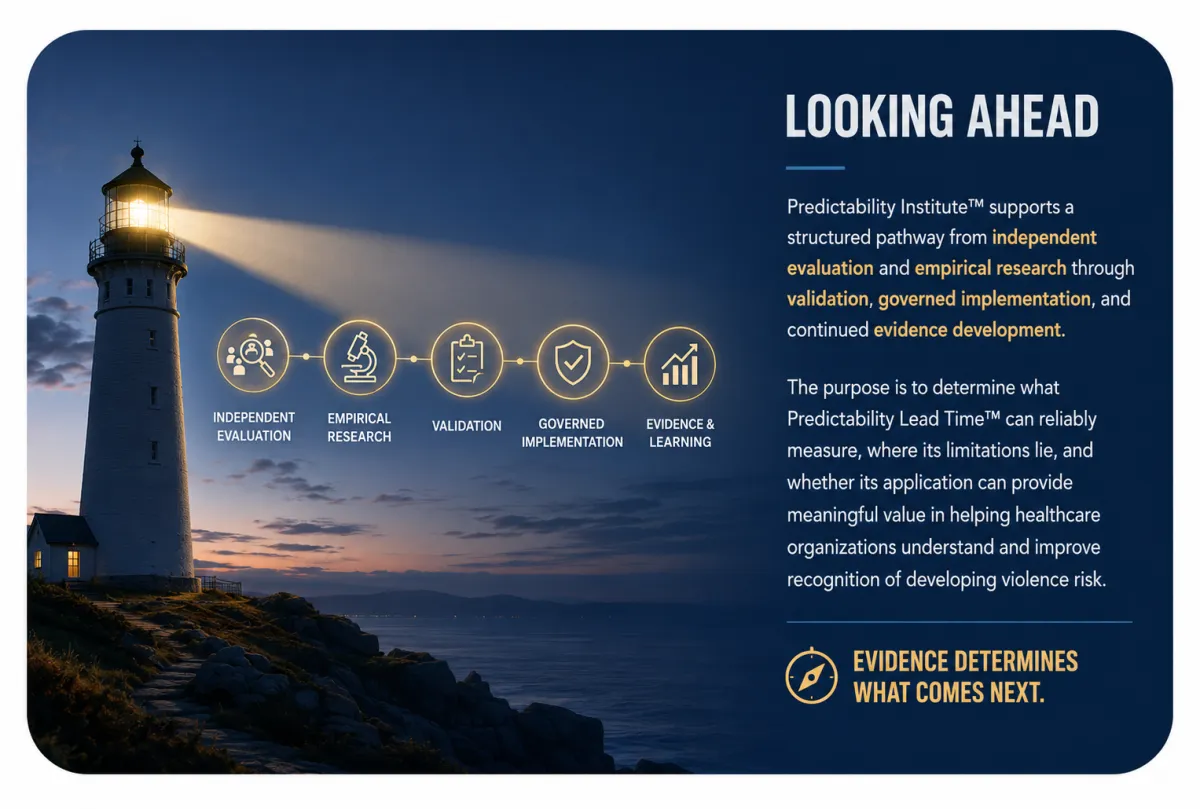
Its next stage is independent evaluation and empirical validation to determine reliability, limitations,
practical value, and the conditions required for responsible implementation.
Founder
Alison Prentice, BsCN
Former Director of Nursing
Founder of Predictability Institute™

Alison Prentice developed Predictability Lead Time™ after decades of observing how healthcare investigates harm, manages risk, and improve safety within healthcare organizations. Her work asks whether meaningful opportunities to recognize predictable harm may exist earlier than traditional investigations often examine, shifting the discussion from only asking why harm occurred to also asking when it first became reasonably recognizable as predictable.
Predictability Institute™ was established to provide an independent home for the continued development, professional evaluation, and responsible stewardship of the framework. Through the Institute, Alison is encouraging discussion, collaboration, independent review, and future research to determine where Predictability Lead Time™ may contribute practical value.
A methodology Built for Collaboration
Predictability Lead Time™ has been developed as a structured analytical methodology and is now moving into its next stage:
independent evaluation, empirical validation, and evidence development.
The Institute welcomes engagement from healthcare organizations, researchers, academic institutions,
quality improvement and risk management professionals, violence prevention specialists, technology and AI organizations, and
potential research and strategic collaborators interested in evaluating, testing, and responsibly advancing the methodology.
learn more
The Predictability Lead Time™ Introduction Series has been developed to introduce the methodology in stages. Each document builds on the one before it, allowing readers to explore the methodology in progressively greater depth.
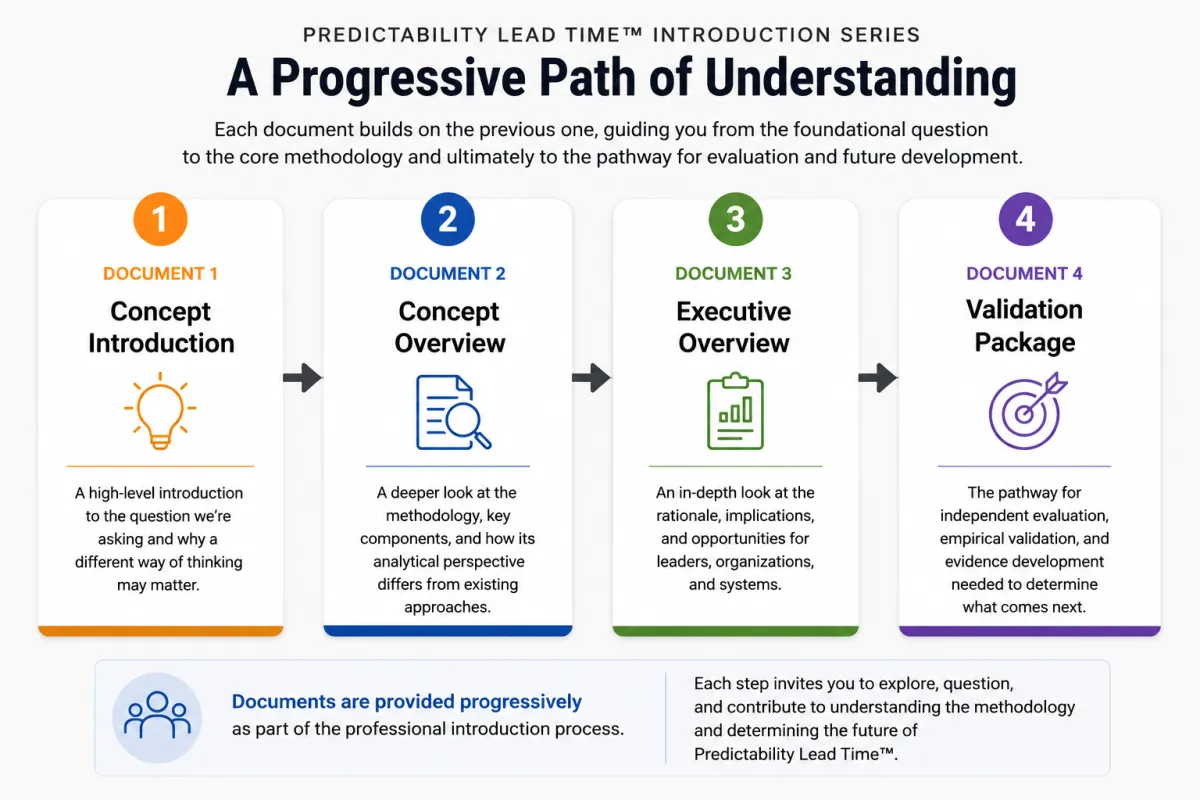
REQUEST THE FIRST IN THE SERIES BELOW
Start the Conversation
Ready to Explore a Different Way of Thinking?
If this methodology is relevant to your work, request the first document in the Predictability Lead Time™ Introduction Series below.
PRIVACY
Your information will be used only to provide access to this publication and to notify you of significant future publications and developments related to Predictability Lead Time™. Your information will not be sold or shared with third parties.


Patient safety changed healthcare by changing how healthcare thought about harm. Predictability Lead Time™ begins by asking whether violence against healthcare workers deserves the same willingness to think differently.

Predictability Institute™ advances new ways to understand and measure predictable harm in healthcare through research, structured assessment methodologies, and professional collaboration.
© 2026 Predictability Institute™. All rights reserved. Predictability Institute™, Predictability Lead Time™, Predictability Marker™, Predictability Timeline™, Organizational Awareness Timeline™, Organizational Awareness Interval™, Response Interval™, Intervention Interval™, and Organizational Acceptance of Predictable Harm™ are trademarks of Alison Prentice.
© 2026 Predictability Institute™ . All rights reserved