Why Safety Culture Is Difficult to Measure in Healthcare
Moving Beyond Perception to Organizational Recognition
Few concepts have influenced healthcare improvement more than safety culture.
Healthcare leaders invest considerable time and resources in understanding it. Organizations conduct safety culture surveys, encourage staff feedback, promote psychological safety, monitor reporting rates, and benchmark results against peer institutions. Regulators, accreditation bodies, and researchers all recognize safety culture as a critical component of high-quality care because culture influences how people communicate, respond to concerns, and make decisions every day.
These efforts have advanced healthcare considerably. A positive safety culture encourages staff to speak up, report concerns, learn from mistakes, and work collaboratively to improve organizational performance. Decades of research have demonstrated the value of these characteristics in creating healthier, more resilient organizations.
Despite that progress, one important question remains surprisingly difficult to answer. How do we know whether an organization's safety culture is actually improving its ability to recognize developing risk before harm occurs?
That question highlights one of the greatest challenges in measuring safety culture. While culture undoubtedly influences organizational performance, its direct impact on recognition is much more difficult to observe.
Safety Culture Cannot Be Seen Directly
Unlike staffing levels, response times, or incident frequencies, safety culture is not directly observable. It represents the shared values, beliefs, assumptions, and behaviours that influence how people think about safety within an organization. Because culture exists within everyday interactions and decision-making, it cannot be measured through a single objective indicator.
Instead, organizations rely on a collection of indirect measures. Safety culture surveys ask employees about communication, teamwork, leadership support, reporting practices, and psychological safety. Focus groups provide additional insight into staff experiences, while reporting systems, turnover rates, and operational performance indicators contribute further evidence.
Together, these measures provide valuable information about how employees perceive their working environment. They help leaders understand whether people feel supported, whether communication is effective, and whether staff believe concerns will be taken seriously.
Those insights are important.
However, perception is not the same as performance.
Measuring Beliefs Is Different from Measuring Outcomes
Consider two hospitals that achieve nearly identical safety culture survey results. Staff in both organizations report strong leadership support, open communication, and confidence that concerns will be addressed. On paper, both organizations appear to have healthy safety cultures.
Several months later, however, each hospital experiences a remarkably similar incident involving escalating aggression toward healthcare workers. In one organization, staff recognize the developing situation early enough to intervene before serious harm occurs. In the other, recognition comes much later, after opportunities for intervention have already narrowed.
If their safety culture scores were so similar, what explains the difference?
The answer may lie in something the surveys were never designed to measure.
Organizational recognition.
Recognition Is an Operational Capability
Every healthcare organization receives information continuously. Staff report concerns. Patients display changing behaviours. Families express frustrations. Policies identify warning signs. Electronic systems generate alerts. Leaders review dashboards and operational reports.
The challenge is rarely the complete absence of information. More often, the challenge is recognizing when individual pieces of information collectively indicate that a developing situation has crossed an important threshold.
Recognition is an operational capability. It reflects how effectively an organization interprets the information it already possesses and translates that awareness into timely action.
A strong safety culture should support that process. Measuring whether recognition itself is improving, however, is considerably more difficult.
Why Traditional Measures Have Limits
This is not a criticism of safety culture surveys. They remain among the most valuable tools available for understanding organizational attitudes, behaviours, and leadership effectiveness.
The challenge is that they answer a different question.
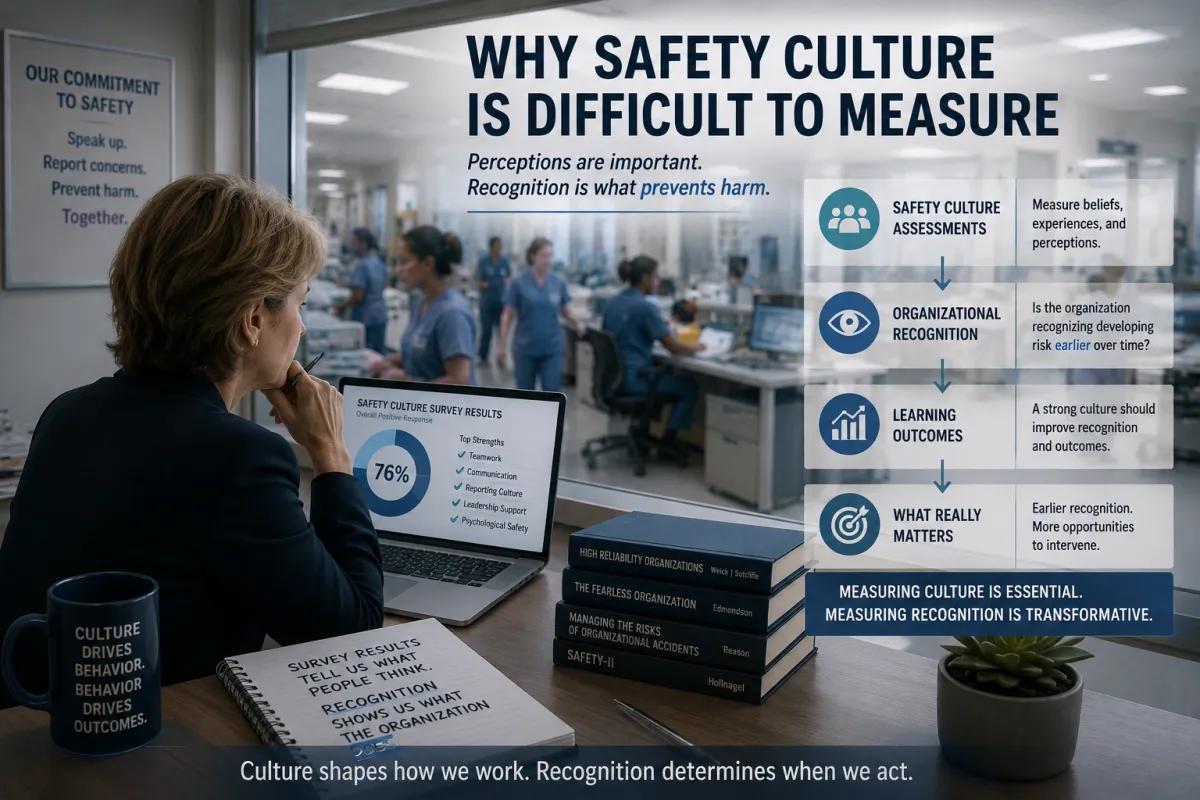
Safety culture surveys tell us how people experience the organization's approach to safety. They do not necessarily tell us whether the organization consistently recognizes emerging risk earlier than it did five years ago.
An organization may report excellent teamwork, strong leadership, and high levels of psychological safety while continuing to recognize recurring risks at exactly the same stage in their development. If recognition has not improved, has the organization actually strengthened its ability to anticipate developing harm?
That question is rarely asked because it has traditionally been difficult to evaluate.
Organizational Learning Should Improve Recognition
One of the defining characteristics of organizational learning is that future performance changes because of past experience. Learning is not simply remembering what happened. It is recognizing similar patterns sooner when they begin to emerge again.
Healthcare organizations investigate incidents, develop corrective actions, revise policies, and educate staff with the expectation that these activities will improve future performance. If that learning is effective, one outcome should become increasingly visible over time.
The organization should recognize developing situations earlier.
Not because it can predict the future, but because it has become better at interpreting the present.
Earlier recognition represents evidence that organizational learning is influencing everyday operations rather than remaining confined to investigation reports, policy documents, and educational programs.
A Different Way to Think About Measurement
Predictability Lead Time™ approaches this challenge from a different perspective. Rather than asking whether staff believe the organization values safety, the methodology asks:
When could this developing situation reasonably have been recognized as becoming predictable?
That question shifts attention from organizational opinion to organizational awareness. It evaluates recognition using documented evidence that existed before the event occurred and examines whether the organization could reasonably have recognized the developing situation at an earlier point in time.
Importantly, this is not intended to replace safety culture assessment.
Safety culture and Predictability Lead Time™ examine different aspects of organizational performance. Safety culture explores the environment that supports safe practice, while Predictability Lead Time™ examines whether that environment contributes to earlier organizational recognition of developing risk.
The two approaches are complementary. One evaluates the conditions that encourage learning. The other evaluates whether that learning produces measurable improvement in organizational recognition.
From Measuring Culture to Measuring Capability
Healthcare has made enormous progress in understanding safety culture over the past three decades. Organizations now recognize the importance of trust, communication, leadership, teamwork, and psychological safety in creating environments where staff feel comfortable raising concerns.
Those advances should continue.
At the same time, healthcare improvement increasingly depends on understanding whether those cultural strengths translate into measurable organizational capabilities. Can the organization recognize emerging risk sooner? Can it identify meaningful patterns earlier? Can it distinguish routine operational variation from situations that are becoming progressively more concerning?
These questions move beyond measuring what people believe.
They begin measuring what organizations actually do.
A Strong Culture Should Leave Evidence
Safety culture is often described as "the way we do things around here."
Perhaps an equally important question is this:
How does the way we do things around here improve the way we recognize developing risk?
If organizational learning is effective, that improvement should leave evidence. Recognition should occur earlier. Awareness should develop sooner. Opportunities for intervention should increase.
Those outcomes may never be captured fully by a survey alone. They may, however, provide one of the clearest demonstrations that a strong safety culture is accomplishing what it was always intended to achieve: helping organizations recognize emerging harm before opportunities for intervention begin to disappear.
#SafetyCulture #HealthcareLeadership #PatientSafety #OrganizationalLearning #QualityImprovement #RiskManagement #PsychologicalSafety #HealthcareInnovation #HealthcareWorkers #PredictabilityLeadTime