Why Every Timeline Tells Two Stories | Predictability Institute
Every serious incident investigation begins in much the same way.
Investigators gather records, review documentation, interview staff, examine security footage, and reconstruct the sequence of events. The result is a timeline that explains what happened, when it happened, and who was involved. That timeline becomes the foundation for understanding the event and, ultimately, for identifying opportunities to improve.
It is an essential part of every investigation.
It is also incomplete.
The timeline tells the story of the event itself, but it rarely tells the story of the organization's awareness while that event was unfolding. It records actions and outcomes with remarkable precision, yet often overlooks the gradual development of recognition that occurred before the final outcome was reached. If the goal is continuous organizational learning, that missing perspective matters.
Imagine reading the final chapter of a novel before reading the rest of the book.
Once you know how the story ends, every earlier clue suddenly appears obvious. A casual remark becomes significant. An unusual behaviour stands out. A seemingly minor detail takes on new meaning. Hindsight changes how we interpret everything that came before.
Incident investigations face the same challenge.
Once an assault has occurred, it is easy to look backward and connect the warning signs. The real question is not whether those signs become visible after the fact. The real question is when they became sufficiently connected that the organization could reasonably have recognized the developing situation before the event reached its conclusion.
That distinction changes how we think about timelines.
The traditional timeline documents the progression of the event. It records admissions, assessments, conversations, escalating behaviours, requests for assistance, interventions, and outcomes. It provides an accurate chronology of what happened, and without it, meaningful investigation would be impossible.
However, those same events are experienced very differently by the people living through them.
Staff do not know how the story ends. They receive information one piece at a time. A nurse notices increasing agitation. A physician documents a behavioural change. A healthcare aide mentions that a patient has become verbally aggressive. Security receives a request to attend the unit. Family members provide additional context. Each observation may seem relatively ordinary when viewed on its own, but together they begin to form a larger picture.
That process has its own chronology.
Organizational awareness does not appear all at once. It develops gradually as information is observed, communicated, interpreted, and shared across the organization. Sometimes recognition occurs quickly because information flows effectively between people and departments. At other times, important observations remain isolated, delaying recognition even though the necessary information already exists somewhere within the organization.
This is why two organizations can experience remarkably similar events and still perform very differently.
On paper, the incidents may appear almost identical. Both organizations cared for patients with similar presentations. Both documented similar behaviours. Both ultimately experienced violence against a healthcare worker. Looking only at the event timeline, there may be little to distinguish one investigation from the other.
The difference often becomes visible only when we examine how organizational awareness developed.
In one organization, staff connected the emerging pattern early. Information moved efficiently, concerns were escalated, and the developing situation was recognized before it reached a critical point. In the other, the same observations remained scattered across different individuals and departments. No single person saw the complete picture until much later. The events may have looked the same, but the organizations were operating with very different levels of awareness throughout the incident.
That difference deserves to be understood.
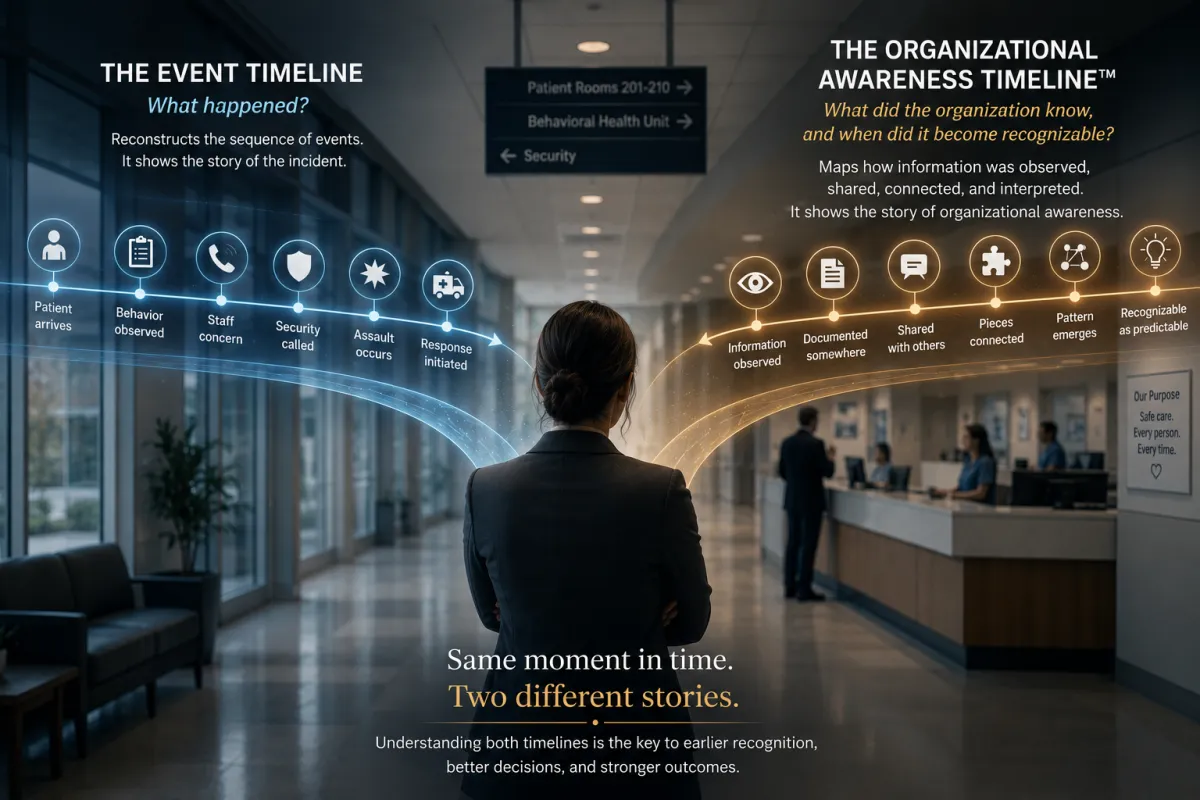
Predictability Lead Time™ proposes that every investigation contains two parallel stories. The first is the familiar story of the event itself. The second is the story of organizational awareness as the situation evolved. Both stories unfold over the same period of time, yet they reveal very different aspects of organizational performance.
The first asks, "What happened?"
The second asks, "What was the organization capable of recognizing at each point as the situation developed?"
Those questions are related, but they are not the same.
The first helps explain the event. The second helps explain the organization's recognition of that event. Together they create a richer understanding of why opportunities for earlier action may have existed and how similar situations might be recognized sooner in the future.
This is not an exercise in assigning blame with the benefit of hindsight. Predictability Lead Time™ is not interested in criticizing decisions made under pressure or suggesting that every adverse outcome could have been prevented. Instead, it asks whether the organization's recognition process can be better understood, measured, and strengthened through systematic analysis.
That is a fundamentally different objective.
Organizations learn a great deal by reconstructing events. They learn even more when they understand how awareness developed before those events reached their conclusion. One tells the story of what happened. The other tells the story of what became recognizable along the way.
Both timelines matter.
But if healthcare is serious about improving organizational learning, it may be time to start giving equal attention to the story that has too often remained untold.
Every investigation reconstructs the past. The greatest opportunity for learning may lie in reconstructing how organizational awareness evolved before the outcome was known.
#PredictabilityLeadTime #HealthcareLeadership #HealthcareSafety #OrganizationalLearning #ViolenceAgainstHealthcareWorkers #PatientSafety #IncidentInvestigation #QualityImprovement #RiskManagement #HealthcareInnovation #SystemsThinking #HealthcareResearch