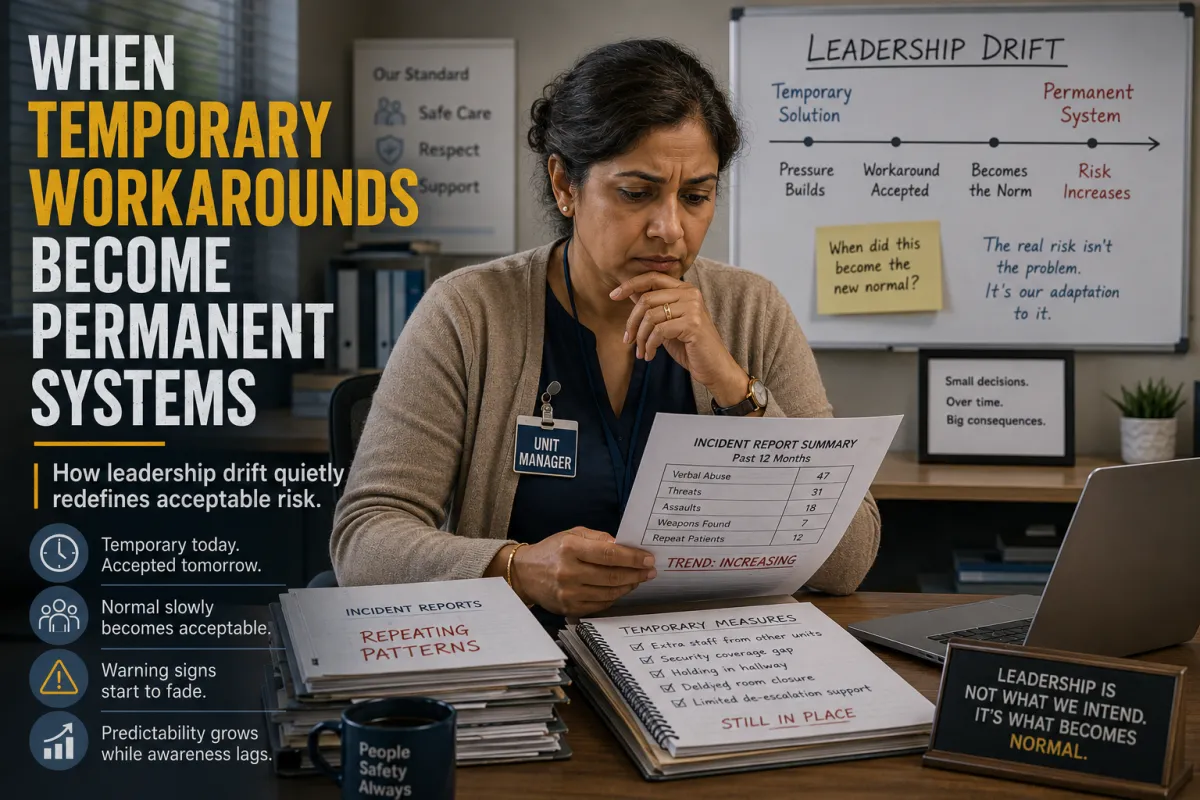
When Temporary Workarounds Become Permanent Systems
How leadership drift quietly redefines acceptable risk
Healthcare organizations deal with temporary problems every day. A staffing shortage, an overcrowded emergency department, a security vacancy, or a sudden increase in patient acuity may all require short-term adjustments. Leaders make difficult decisions to keep services operating while waiting for conditions to improve.
There is nothing inherently wrong with temporary workarounds. In many situations they are necessary. The real danger begins when those workarounds quietly become permanent ways of operating, without anyone formally deciding that the new level of risk is acceptable.
Temporary Solutions Have a Habit of Staying
Most organizational change happens gradually rather than suddenly. A vacant security position is left unfilled for a few months because recruitment is difficult. Staff agree to cover additional patients until more nurses are hired. A unit continues operating without environmental improvements because funding has been delayed.
Each decision seems reasonable when viewed in isolation. After all, healthcare leaders must constantly balance competing priorities with limited resources. The problem is that temporary arrangements often outlive the circumstances that created them, eventually becoming embedded in everyday practice.
Months later, staff no longer describe these measures as temporary. They simply become "how things are done here."
Leadership Drift Is Usually Invisible
Few leaders intentionally lower safety standards. More often, standards drift because organizations adapt to ongoing pressures instead of resolving them. What once required special approval gradually becomes routine, and practices that would previously have raised concern no longer attract attention.
This gradual shift is sometimes referred to as leadership drift. It is not usually the result of negligence or indifference. Instead, it reflects the cumulative effect of countless small decisions made in response to immediate operational demands. Over time, those decisions redefine what the organization considers normal.
That change is subtle enough that many people do not recognize it while it is happening.
Risk Changes Long Before Policies Do
One of the challenges with organizational drift is that formal policies often remain unchanged while day-to-day practice slowly evolves. The written expectations continue to describe one standard, while operational reality begins reflecting another.
Staff become accustomed to waiting longer for assistance. They learn which situations require security and which they are expected to handle themselves. High-risk behaviours that once prompted immediate review gradually become viewed as part of the job.
None of these changes occur overnight. Each one represents a small adjustment to ongoing pressure. Together, however, they can significantly increase the likelihood that violence against healthcare workers will occur.
Adaptation Can Hide Growing Predictability
The more familiar a risk becomes, the less attention it often receives. Repeated exposure can create the impression that a hazardous situation is simply unavoidable, even when warning signs continue to accumulate.
Predictability Lead Time™ approaches these situations from a different perspective. Rather than asking only why an assault occurred, it asks when the available information could reasonably have supported recognizing that the situation was becoming predictable.
Temporary workarounds frequently contribute to that timeline. Every extension of an interim measure, every repeated incident, and every unresolved concern may add to the evidence that organizational risk is changing. While no single event may appear significant on its own, the cumulative pattern may tell a very different story.
Temporary Should Mean Temporary
Healthcare will always require flexibility. Emergencies happen. Staffing pressures fluctuate. Unexpected challenges are inevitable. Temporary measures are often an appropriate response, provided they remain exactly that: temporary.
Leaders should periodically ask whether a workaround still serves its original purpose or whether it has quietly become the accepted operating model. They should also consider whether the level of risk associated with that workaround has changed over time, particularly if staff concerns or incident reports continue to accumulate.
These questions are not about assigning blame. They are about recognizing organizational drift before it becomes normalized.
When Systems Change, Predictability Changes
Organizations rarely wake up one morning to discover that acceptable risk has dramatically increased. The change is usually incremental, occurring through dozens of small operational decisions that seem reasonable at the time.
By the time a serious assault occurs, those temporary adjustments may have existed for months or even years. The organization may have adapted so completely that the conditions no longer appear unusual, despite the growing body of evidence suggesting otherwise.
That is why Predictability Lead Time™ focuses on recognizing the earliest point at which violence could reasonably have been identified as becoming predictable. Understanding when temporary problems became permanent systems may be one of the most important questions healthcare organizations have yet to ask.
#HealthcareLeadership #WorkplaceViolence #HealthcareSafety #PatientSafety #RiskManagement
#HealthcareQuality #NursingLeadership #OrganizationalCulture #PredictabilityLeadTime
#PredictabilityInstitute