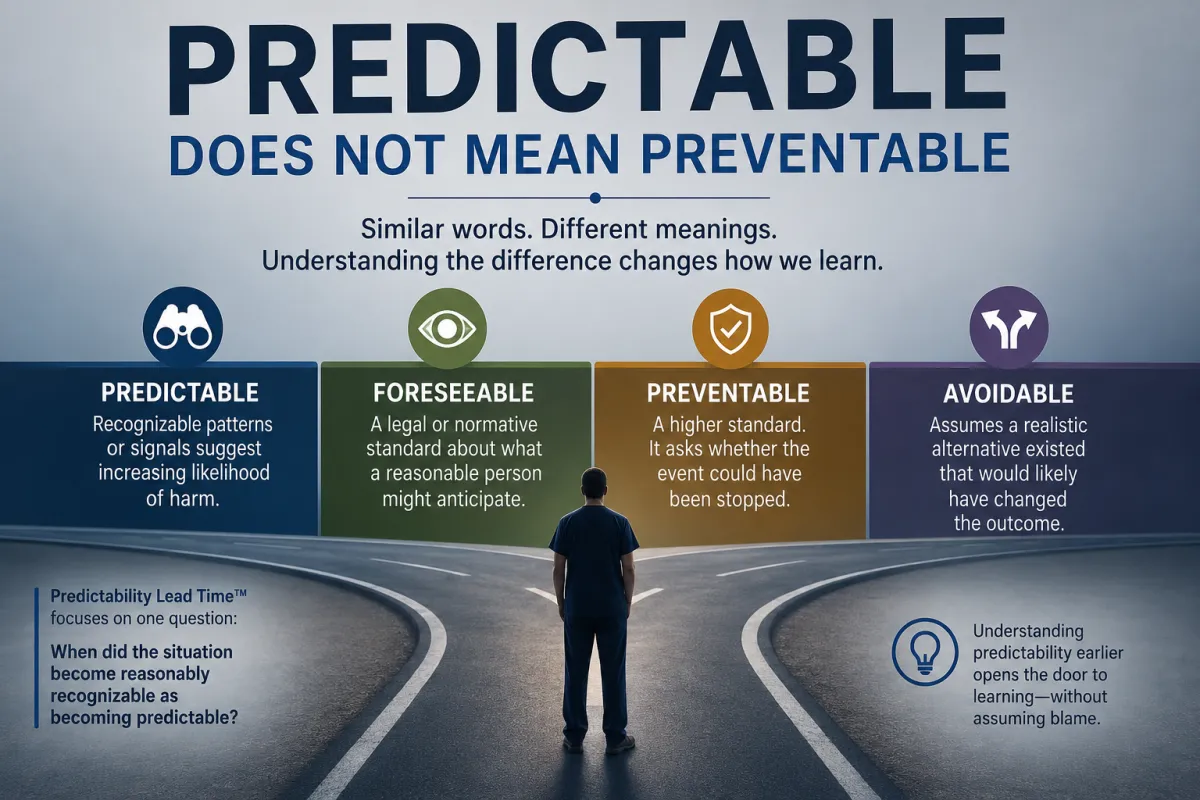
Predictable Does Not Mean Preventable
Words Matter
One of the biggest misunderstandings surrounding Predictability Lead Time™ is the assumption that if an event became predictable, it must also have been preventable. That conclusion is understandable, but it confuses several concepts that are often used interchangeably despite having very different meanings.
Predictable. Foreseeable. Preventable. Avoidable.
These words frequently appear together in discussions about workplace violence, risk management, and patient safety. In everyday conversation they may sound almost synonymous. In professional practice, however, they describe different ideas. Confusing them can influence how incidents are investigated, how responsibility is assigned, and how opportunities for learning are either recognized or overlooked.
Predictability Lead Time™ focuses on one question only. It asks when a situation may have become reasonably recognizable as progressing toward harm. It does not assume the harm could have been prevented. That is a separate question requiring its own evidence.
Predictability Is About Recognition, Not Certainty
Predictability is often misunderstood because people associate it with certainty. If something was predictable, they assume someone should have known exactly what would happen. That is not how prediction works in almost any other field.
Meteorologists cannot predict the precise path of every thunderstorm, yet they recognize atmospheric conditions that increase the probability of severe weather. Financial analysts cannot predict every market movement, but they identify indicators that suggest rising risk. Emergency physicians cannot predict which patient will deteriorate during the next hour, yet they recognize clinical patterns that demand closer observation.
Healthcare workers make similar judgments every day. Escalating behaviour, repeated verbal aggression, increasing agitation, environmental stressors, communication failures, or previous incidents may collectively suggest that the risk of violence is increasing. None of these observations guarantees that an assault will occur. They simply indicate that the situation may be changing in a meaningful way.
Recognizing increasing likelihood is fundamentally different from predicting certainty.
Foreseeability Serves a Different Purpose
The term foreseeable often carries legal significance. Courts frequently examine whether a reasonable person should have anticipated that harm might result from a particular set of circumstances. That assessment helps determine questions of negligence, liability, or duty of care.
Predictability Lead Time™ is not intended to answer legal questions.
Instead, it asks whether there was an earlier point in the progression of events when the developing situation had become sufficiently recognizable to warrant analytical attention. That distinction matters because organizations can learn from patterns of escalating risk without making assumptions about legal responsibility.
The framework is therefore descriptive rather than accusatory. It seeks to understand the evolution of risk, not to establish fault.
Prevention Is a Much Higher Standard
The word preventable introduces an entirely different level of analysis.
An event may become increasingly predictable while remaining impossible to prevent. Healthcare environments are dynamic, resource constrained, and often unpredictable despite the experience and competence of those involved. Staff may recognize that a patient's behaviour is escalating yet have limited options available. Security resources may already be engaged elsewhere. Clinical obligations may prevent immediate intervention. Family dynamics, mental illness, intoxication, or environmental conditions may continue driving the situation despite appropriate responses.
Looking back after an incident, it is easy to identify moments where different actions appear obvious. Real-time decision making rarely offers that luxury.
The existence of warning signs should not automatically be interpreted as proof that violence could have been stopped. Predictability and preventability occupy different positions on the analytical pathway.
Avoidability Depends on Realistic Alternatives
Avoidability asks another question altogether. It assumes that a practical alternative existed and that choosing differently would probably have changed the outcome.
Sometimes that is true.
Sometimes every available option carries significant risk, and every reasonable decision still leads to harm. Healthcare professionals regularly make difficult choices under conditions of uncertainty, competing priorities, and incomplete information. Judging those decisions retrospectively can create an unrealistic expectation that better choices were always available simply because the final outcome is now known.
That is one reason hindsight bias remains such a persistent challenge during investigations.
Why Separating These Concepts Matters
If every discussion about predictability immediately becomes a discussion about blame, organizations may unintentionally discourage honest examination of how violence develops. Staff may hesitate to identify early warning signs if they believe doing so automatically implies someone should have acted differently.
Separating predictability from preventability creates room for learning without immediately assigning responsibility. Investigators can first examine whether escalating risk became recognizable before considering whether any practical interventions were available, feasible, or likely to succeed.
Those are different questions. They deserve different analyses.
A Better Question Comes First
Healthcare has made remarkable progress by asking why adverse events occurred. Predictability Lead Time™ does not replace that question. It proposes adding another.
When did this situation become reasonably recognizable as becoming predictable?
Answering that question does not establish negligence. It does not prove preventability. It does not imply that staff failed or that organizations missed an obvious opportunity.
It simply acknowledges that harmful events often evolve over time. By understanding when predictability begins to emerge, healthcare may gain another opportunity to study escalation before harm occurs rather than only explaining it afterward.
That shift in perspective is the foundation of Predictability Lead Time™.
#HealthcareLeadership #WorkplaceViolence #HealthcareSafety #RiskManagement #QualityImprovement #PatientSafety #OrganizationalLearning #HealthcareInnovation #PredictabilityLeadTime #HealthcareResearch