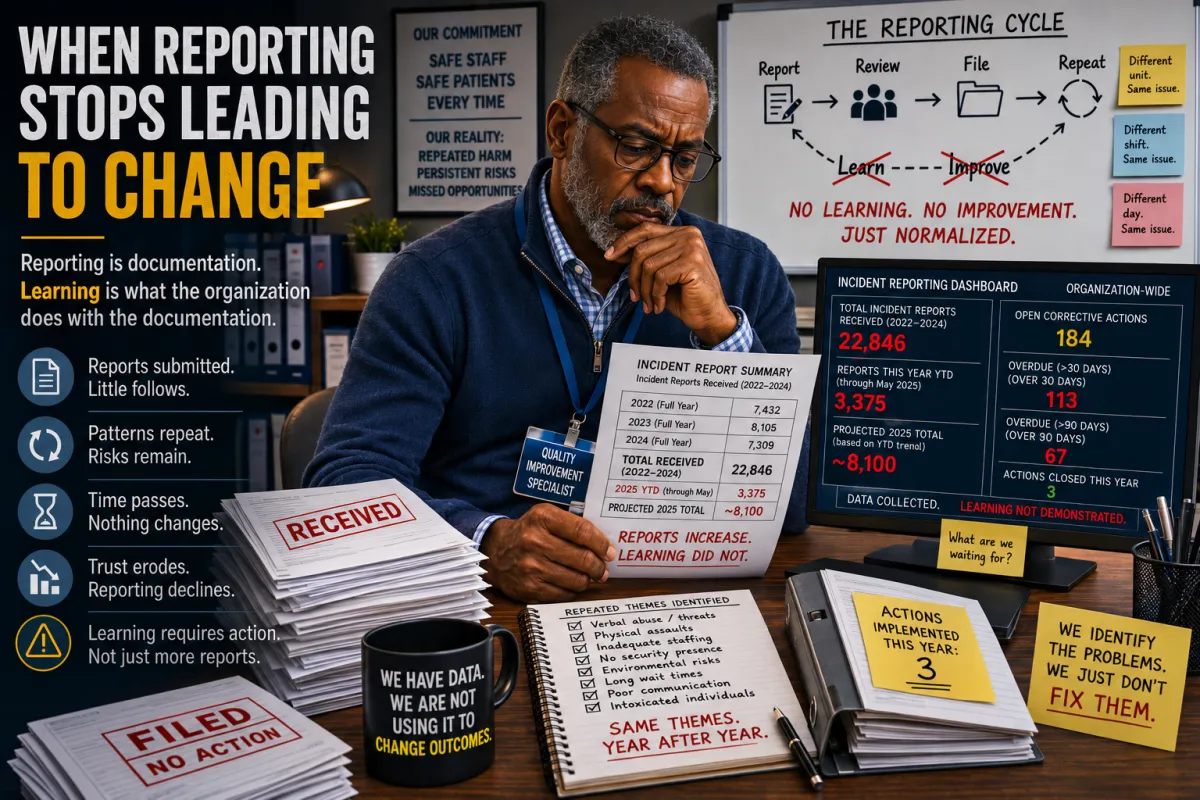
When Reporting Stops Leading to Change
Reporting is documentation. Learning is what the organization does with the documentation.
Healthcare organizations encourage staff to report workplace violence. Incident reporting systems exist to capture what happened, identify patterns, and support improvements that reduce future harm. In theory, every report represents an opportunity to learn.
That is the purpose of reporting.
Yet in many organizations, staff eventually reach a different conclusion. Reports are completed, acknowledged, filed, and rarely discussed again. The process continues, but the expectation that reporting will lead to meaningful change quietly begins to disappear.
Reporting Fatigue Is More Than Frustration
Healthcare workers generally understand why incident reports matter. Most are willing to spend valuable time documenting difficult events if they believe the information will be used to improve safety.
Problems arise when the same hazards are reported repeatedly with little visible response. Staff begin recognizing familiar patterns, yet the organizational response appears unchanged. Over time, reporting starts to feel less like a mechanism for improvement and more like an administrative requirement.
The report still gets completed.
Confidence that it will change anything slowly fades.
Documentation Is Not the Same as Learning
Collecting information is only the first step. Learning requires organizations to interpret that information, identify emerging patterns, and translate those findings into action.
An organization may possess thousands of incident reports while learning very little from them. Data can accumulate for years without fundamentally changing how risks are understood or managed. Documentation alone does not improve safety.
Learning occurs only when information changes decisions.
Every Repeated Report Tells Two Stories
An incident report describes a specific event. A series of similar reports tells a very different story.
One assault may represent an isolated occurrence. Twenty reports describing the same hazards, the same environmental conditions, or the same operational pressures suggest something else entirely. They indicate that the organization has accumulated evidence over time.
The question is no longer whether an incident occurred.
The question becomes whether the organization recognized what those repeated reports were collectively saying.
The Missed Opportunity
Predictability Lead Time™ proposes that every report contributes to an evolving picture of organizational awareness. Individual reports may appear unrelated, but together they begin revealing patterns that would not be visible from any single incident.
Viewed this way, incident reporting is not simply historical documentation. It becomes evidence that may help identify the point at which violence against healthcare workers could reasonably have been recognized as becoming predictable.
That shifts the purpose of reporting. Instead of asking only what happened yesterday, organizations begin asking what the growing body of evidence was already telling them.
Measuring Learning Instead of Reporting
Many organizations measure how many incident reports are submitted. Far fewer measure whether those reports resulted in organizational learning.
How quickly were recurring patterns identified?
What changed because of those findings?
Did repeated reports shorten the time required to recognize emerging risks, or did the same concerns continue appearing year after year?
Those questions may provide a more meaningful measure of organizational learning than reporting volume alone.
Reporting Should Create Better Questions
Incident reporting should never become an exercise in simply documenting harm. Its greatest value lies in helping organizations recognize patterns early enough to think differently about the risks they face.
When reports stop leading to learning, the reporting system has not necessarily failed. More often, the organization has stopped asking enough of the information it already possesses.
Perhaps the most important question is not how many reports were completed.
It is whether those reports changed how the organization understood what was becoming increasingly predictable.
#HealthcareLeadership #QualityImprovement #IncidentReporting #WorkplaceViolence #HealthcareSafety #RiskManagement #PatientSafety #OrganizationalLearning #PredictabilityLeadTime #PredictabilityInstitute