The Most Dangerous Risks in Healthcare Are the Ones That Look Normal
Healthcare organizations are constantly looking for risk.
They conduct incident investigations, monitor quality indicators, review safety reports, analyze trends, and implement corrective actions intended to reduce the likelihood of future harm. These activities are essential. They form the foundation of modern quality improvement and demonstrate an organization's commitment to learning from adverse events.
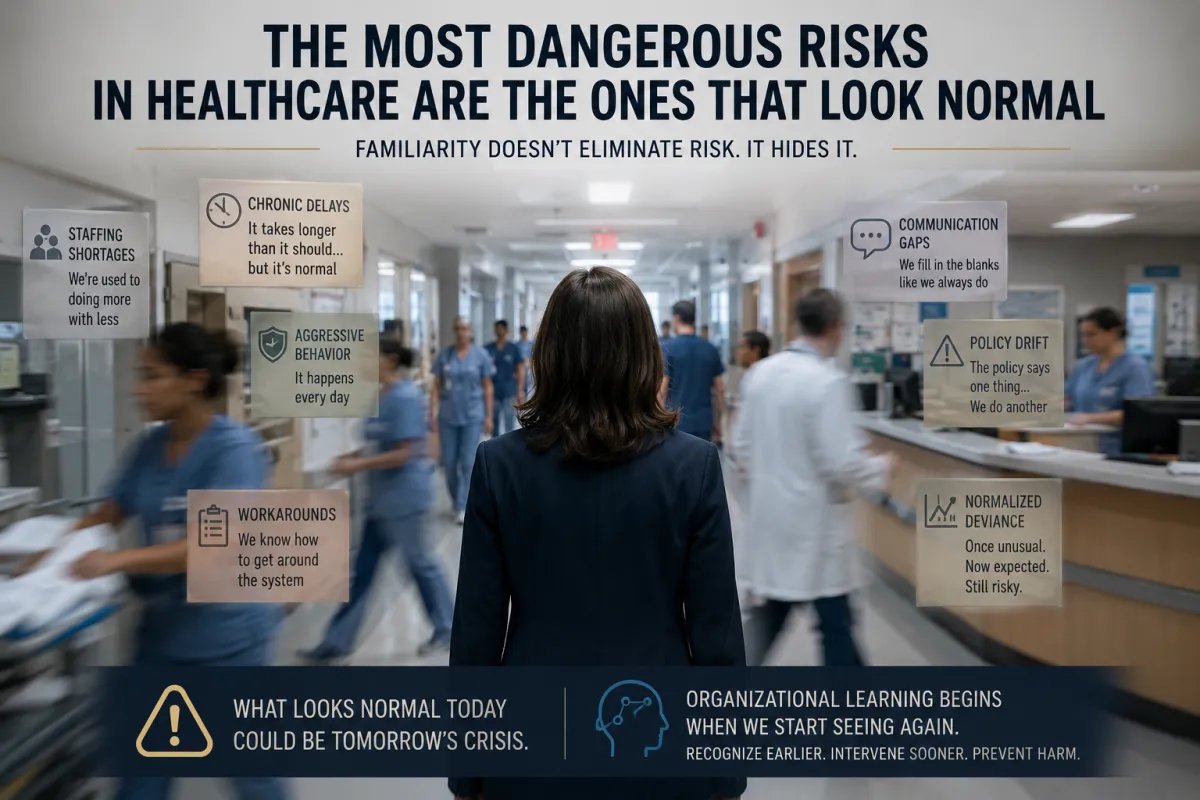
Yet many of the greatest risks in healthcare are not hidden because they are difficult to find. They are hidden because they have become familiar.
When an unsafe condition persists long enough, it often stops attracting attention. Staff adapt. Workarounds become routine. Expectations shift. Behaviours that would once have prompted concern gradually become accepted as simply "the way things are."
The danger is not that organizations ignore risk. The danger is that they eventually stop recognizing it.
Normalization Changes What Organizations See
Researchers have long recognized the phenomenon known as the normalization of deviance. The term describes a process in which deviations from expected standards gradually become accepted because they do not immediately produce catastrophic outcomes. Each successful work-around reinforces the belief that the situation is manageable, even when the underlying risk continues to grow.
Healthcare organizations experience this process every day. A unit becomes chronically understaffed, yet patient care continues. Aggressive behaviour from patients or visitors becomes increasingly common, but staff learn techniques to cope. Equipment failures become predictable enough that employees instinctively know which backup process to follow. Documentation delays become expected rather than exceptional.
None of these situations necessarily trigger immediate harm. Because the organization continues to function, the abnormal slowly begins to appear normal. Over time, what originally represented a warning signal becomes part of everyday operations.
The organization's ability to recognize deteriorating conditions begins to erode.
Adaptation Is Often Mistaken for Improvement
Healthcare professionals are remarkably adaptable. When barriers appear, they find ways to continue providing care. They rearrange priorities, help one another, improvise temporary solutions, and develop informal processes that keep the system functioning despite increasing pressure.
These adaptations are often celebrated because they demonstrate resilience. In many situations, they deserve to be. However, resilience has a hidden consequence. Every successful adaptation can also conceal a system weakness.
If nurses consistently find ways to compensate for inadequate staffing, leadership may never fully appreciate the operational risk that staffing shortage creates. If security personnel repeatedly de-escalate aggressive situations without injury, the organization may conclude that existing processes are working effectively. If physicians routinely compensate for communication failures through informal conversations, the underlying communication system may never receive attention.
The system appears stable because its people are continuously preventing it from failing. Ironically, the organization's greatest strength can make its greatest vulnerabilities more difficult to recognize.
Investigation Reports Capture Events, Not Normalization
Incident investigations are exceptionally valuable. They explain what happened, identify contributing factors, and recommend improvements based on available evidence. What they cannot easily demonstrate is the gradual cultural shift that occurred before the event.
An investigation may identify inadequate staffing, delayed communication, repeated aggressive behaviour, or policy non-compliance as contributing factors. What it often cannot show is that these same conditions had quietly become accepted months or even years before the incident occurred. By the time serious harm finally happens, organizational expectations may already have changed.
Staff no longer perceive the conditions as unusual because they have learned to function within them.
The investigation captures the event. It rarely captures the normalization process that made the event increasingly predictable.
Organizational Learning Should Change Recognition
This distinction is particularly important when viewed through the lens of organizational learning. Learning is often measured by the actions taken after an incident. Policies are revised. Education is delivered. New procedures are introduced. Additional reporting requirements are implemented.
These activities demonstrate organizational memory. Whether they demonstrate organizational learning depends on something different. Has the organization's ability to recognize developing risk actually improved?
If similar situations continue to be recognized at exactly the same point in their development, despite years of investigations and corrective actions, it becomes reasonable to ask whether the organization has learned to see risk any earlier than before.
Learning should influence perception. It should strengthen an organization's sensitivity to emerging conditions that have previously resulted in harm. If recognition remains unchanged, learning may be more procedural than operational.
Predictability Lead Time™ Asks a Different Question
This is where Predictability Lead Time™ introduces a different perspective. Rather than focusing exclusively on why an event occurred, the methodology asks:
When could this developing situation reasonably have been recognized as becoming predictable?
That question directs attention away from the event itself and toward the evolution of organizational awareness. The objective is not to identify blame or suggest that every predictable event was preventable. Instead, it evaluates whether recognition could reasonably have occurred earlier based on the information that was available at the time.
Normalization becomes highly relevant because it directly affects recognition. Conditions that appear ordinary rarely prompt action. Conditions that remain recognizable as unusual are far more likely to receive attention before harm occurs. Viewed this way, normalization is not simply a cultural issue.
It becomes a measurable influence on organizational awareness.
Seeing Risk Requires Continual Recalibration
Healthcare organizations operate in environments of constant change. Patient populations evolve. Workforce shortages fluctuate. Technology advances. Clinical demands increase. Operational pressures shift.
Because organizations continually adapt, they must also continually recalibrate what they consider acceptable. Without deliberate reflection, yesterday's exception can easily become today's expectation.
That recalibration requires more than reviewing incidents after they occur. It requires periodically asking whether recurring conditions have quietly crossed the line from temporary challenge to accepted operating practice. Leaders who ask these questions are often surprised by the answers.
Processes that frontline staff have accepted for years may never have been formally evaluated because they no longer attract attention. The greatest organizational blind spots are often those that nobody thinks to question anymore.
Recognizing Risk Earlier Is a Hallmark of Learning
Organizations that mature in their approach to safety do more than improve investigations. They improve recognition. Weak signals are identified sooner. Patterns are noticed earlier. Emerging risks receive attention before they become routine. Staff become increasingly comfortable challenging conditions that have gradually become accepted.
Perhaps most importantly, leaders remain curious about processes that appear stable on the surface. They understand that stability achieved through constant adaptation may conceal growing organizational vulnerability. This represents one of the clearest indicators of organizational learning.
The organization has not simply accumulated more information. It has changed how it interprets the information it already possesses.
Looking Normal Should Never End the Conversation
Many of healthcare's greatest risks do not announce themselves dramatically. They arrive gradually. They become familiar. Eventually, they disappear into the background of everyday work. That familiarity can be comforting because it creates the impression that the organization has adapted successfully.
Sometimes it has. Sometimes it has simply become accustomed to operating closer to the edge than anyone realizes. The challenge for healthcare leaders is to resist confusing familiarity with safety. The conditions that receive the least attention are not always the least dangerous.
Sometimes they are simply the ones that have looked normal for the longest.
#HealthcareLeadership #PatientSafety #SafetyCulture #OrganizationalLearning #QualityImprovement #RiskManagement #HealthcareInnovation #HealthcareWorkers #ViolencePrevention #PredictabilityLeadTime